JaxPlays applauds our sponsors. Join them.
A Sweltering Room of Stubborn Men: Alhambra's '1776' Lets the Drama Breathe
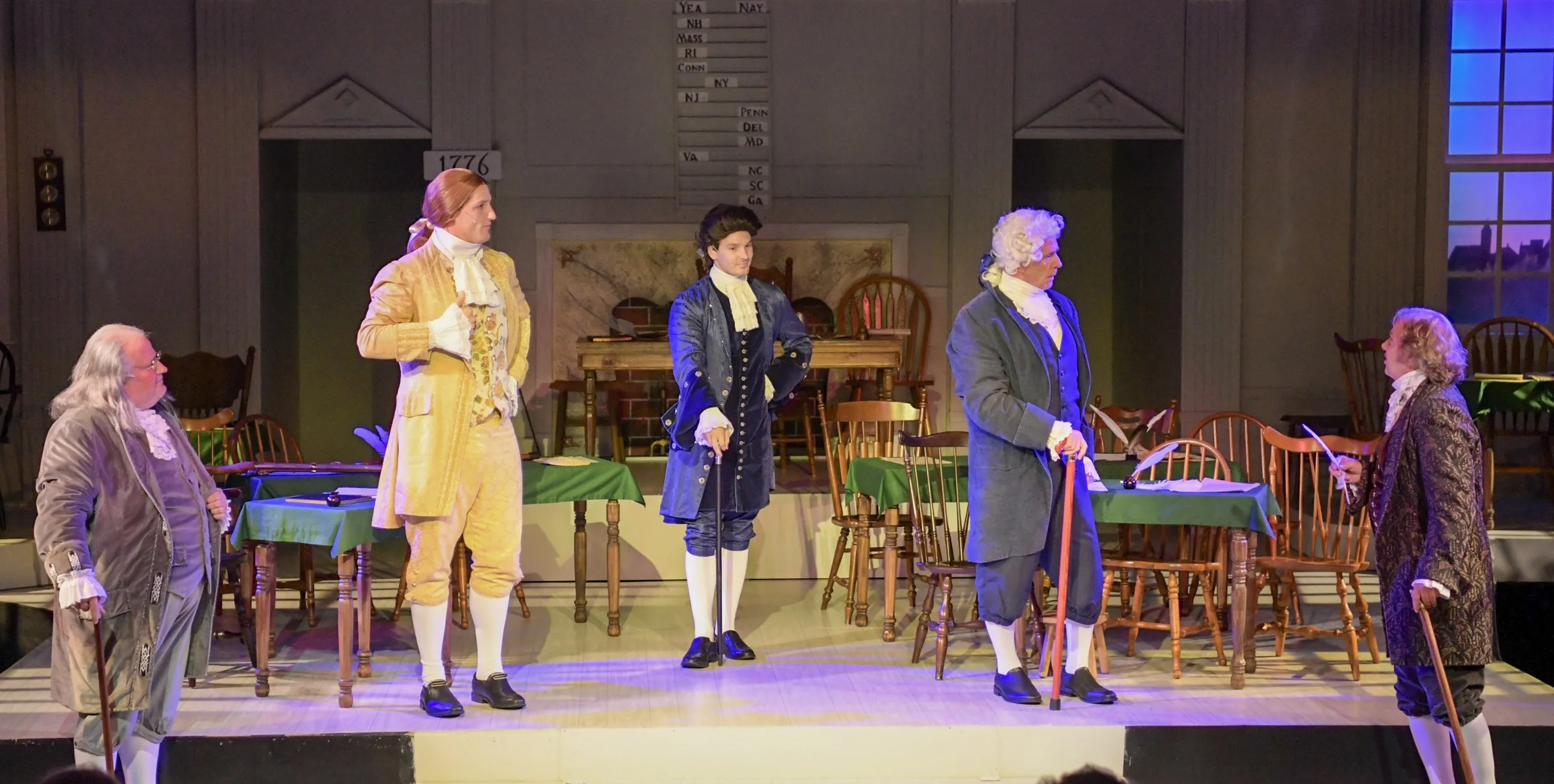
- 6 minutes read - 1154 wordsAlhambra Theatre & Dining’s 1776 is a slow burner that asks you to settle in, lean forward and listen. Under Tod Booth’s patient direction, the production resists every modern temptation to juice the pacing or punch up the politics. Instead, it trusts Sherman Edwards and Peter Stone’s talky, argumentative musical to do what it does best: turn a sweltering Philadelphia room full of stubborn men into a piece of theatre that earns every degree of its eventual catharsis.
For the uninitiated, 1776 dramatizes the weeks of cantankerous debate inside the Second Continental Congress that ended — improbably and incompletely — with thirteen colonies signing the Declaration of Independence. It’s a musical that values rhetoric over razzle-dazzle, long stretches of pure argument punctuated by some of the most distinctive numbers ever written for the form. Done poorly, it can feel like an endurance test. Done well, it sneaks up on you and leaves you shaken. This one sneaks up on you.
You can hear Cathy Murphy Giddens’s hand the moment the choir opens “Sit Down, John” — the blend is locked, the entrances are surgical, the dynamics are doing real work from the downbeat. That kind of opening only happens when the music director knows the score cold, and Giddens holds the company to that standard all night. “But, Mr. Adams” is especially well-served, the committee’s overlapping voices leaning into a handful of sour, unresolved suspensions that give the number a delicious tartness it tends to lose in politer hands.
At the center of the evening is Kevin Anderson’s John Adams, and he is an absolute delight. Anderson plays Adams as a man whose dry humor isn’t a defense mechanism but a worldview — he’s genuinely smarter, funnier and more righteous than the room and he knows it, which is precisely what makes him so intolerable to his colleagues. The performance lets the character’s irritability breathe without ever tipping into shtick, giving the production its credible spine.
Robert Butterly’s Benjamin Franklin is the comic engine, hilarious nearly nonstop. Butterly understands that Franklin’s job in this show is to be the wit that keeps the audience leaning forward when the rhetoric thickens, and he hits that mark with a relaxed authority — like a man who has been telling these jokes for two centuries and still finds himself amusing.
Thaddeus Walker brings it as John Dickinson. His Dickinson drips with disdain and barely-contained fury — a performance with real teeth, which the show desperately needs if its central conflict is going to feel like anything other than a foregone conclusion. Walker makes Dickinson’s resistance feel noble and dangerous rather than merely obstructive, and the production is sharper for it.
Jake Delaney’s Richard Henry Lee is a delight in the opposite register: a Gumby cartoon of a man, all limbs and bravado, sailing through “The Lees of Old Virginia” with the kind of physical commitment the number begs for. It is exactly the comic energy this show wants from Lee, and Delaney pays it in full.
Ryan Lemmon makes a meal of Charles Thomson, the Congress’s beleaguered secretary. The role is easy to underplay, but Lemmon’s bone-dry, exactly-timed and just-a-touch put-upon delivery turns Thomson into a recurring laugh line and, more importantly, a recognizable human being trapped in a room full of louder ones. Kenneth Uibel’s Andrew McNair is cut from similar cloth — a crabby curmudgeon in the best possible sense, sour and indispensable. Alec Hadden’s John Hancock is a light comic garnish sprinkled throughout the evening, all exasperated dignity as he gavels for order against the men, the flies and the general entropy of the room.
The women in 1776 are few but never decorative, and this production knows it. Rachel Ann Kocher’s Abigail Adams is vocally crystal clear and quietly spectacular — the kind of singing that doesn’t show off because it doesn’t need to. Kocher plays her with warmth, matronly steel and a wit every bit as sharp as her husband’s, which makes her the perfect foil for Anderson’s Adams: where he meets the room with bristle and bluster, she meets him with humor and an affection that grounds him. Sofia Lourdes’s Martha Jefferson is exquisite, vocally and dramatically, delivering a passionate, full-throated performance that lands a much-needed jolt of humor and romantic warmth in the middle of an otherwise lawyerly evening.
Brennan A. Moritz’s Courier carries the weight of “Momma Look Sharp,” and the number lands as the show’s emotional gut-punch — though not the way anyone planned. At the performance reviewed, Moritz’s mic dropped out mid-song. What could have been a disaster turned into one of the most arresting moments of the evening: Moritz never flinched, simply opened up his projection and kept singing, while the audio engineer, Aaron McCaskill, met him halfway by pulling the backing track down. The accidental result was a nearly unamplified rendition that pulled the entire house forward in their seats, leaning in to catch every word of an already gut-wrenching ballad. That kind of in-the-moment professionalism — from both the actor on stage and whoever was at the board — is the difference between a derailed number and a serendipitous, unforgettable one.
And then there is Coleman David Campbell’s Edward Rutledge, the supporting turn that reorganizes the show around itself. Campbell plays him with an accent thick as molasses and a contempt cold enough to feel like a threat. His “Molasses to Rum” doesn’t try to win the room — it methodically dismantles the Northern delegates’ moral high ground, laying out how the same New England merchants calling the South immoral are getting fat off the triangle trade they claim to abhor. Nobody is converted. What Campbell delivers is worse: the men in the room — and the audience watching them — are left to sit with an uncomfortable truth.
Booth’s direction is patient, but 1776 has never been a fast musical — pretending otherwise tends to break it. By letting the long debate scenes sit at their natural temperature, this production allows the score’s emotional eruptions to land with the weight they were designed to carry. Johnny Pettegrew’s lighting and David Dionne’s set support the approach without pulling focus, and the period costumes by Camala Pitts and Dorinda Quiles do the same.
What this 1776 gets right is the hardest thing about the show to get right: the sense that the room is hot, the men are tired, the argument is real, and the outcome — even when you already know how it ends — is not guaranteed. The comedy lands because the cast is playing the stakes, not the jokes. The drama lands because nobody is in a hurry to escape it.
If you’ve been waiting for a 1776 that trusts you to sit with it, this is the one. Anderson, Butterly, Walker, Lourdes and Kocher are all doing standout work, and Campbell’s Rutledge alone is reason enough to make the trip.
1776 runs Thursday, May 14 through Sunday, June 14 at the Alhambra Theatre.
For more information, full cast and crew credits and links to tickets, visit the 1776 page here on JaxPlays.
JaxPlays applauds our sponsors. Join them.