JaxPlays applauds our sponsors. Join them.
'The Pillowman' at Lumen Rep Delivers Powerful Questions and a Punishing Runtime
- 5 minutes read - 950 wordsLumen Repertory Theatre’s The Pillowman is a gripping, gorgeously executed production elevated by mesmerizing performances, stunning technical design and confident direction that navigates the play’s tonal minefields with precision. Martin McDonagh’s dark psychological thriller asks important questions about storytelling, cruelty, state power and the moral responsibility of art, and Lumen Rep meets those questions with seriousness, precision and theatrical force. Those questions matter. They deserve to be asked. Unfortunately though, important stories are not always the same thing as entertaining theater. Where the evening falters, it’s not from a lack of craft in the production, but from a script that too often mistakes endurance for profundity.
Directed by Joshua Britton Andrews, this staging maintains a brisk pace where it can, while still allowing key moments to linger long enough to do their damage. That balancing act is no small feat in a play this dense, this talky and this structurally demanding. At more than two and a half hours, broken mercifully by the brief respite of two intermissions, the evening asks a great deal of its audience — more than it strictly needs to — but the production works tirelessly to keep that burden from collapsing under its own weight.
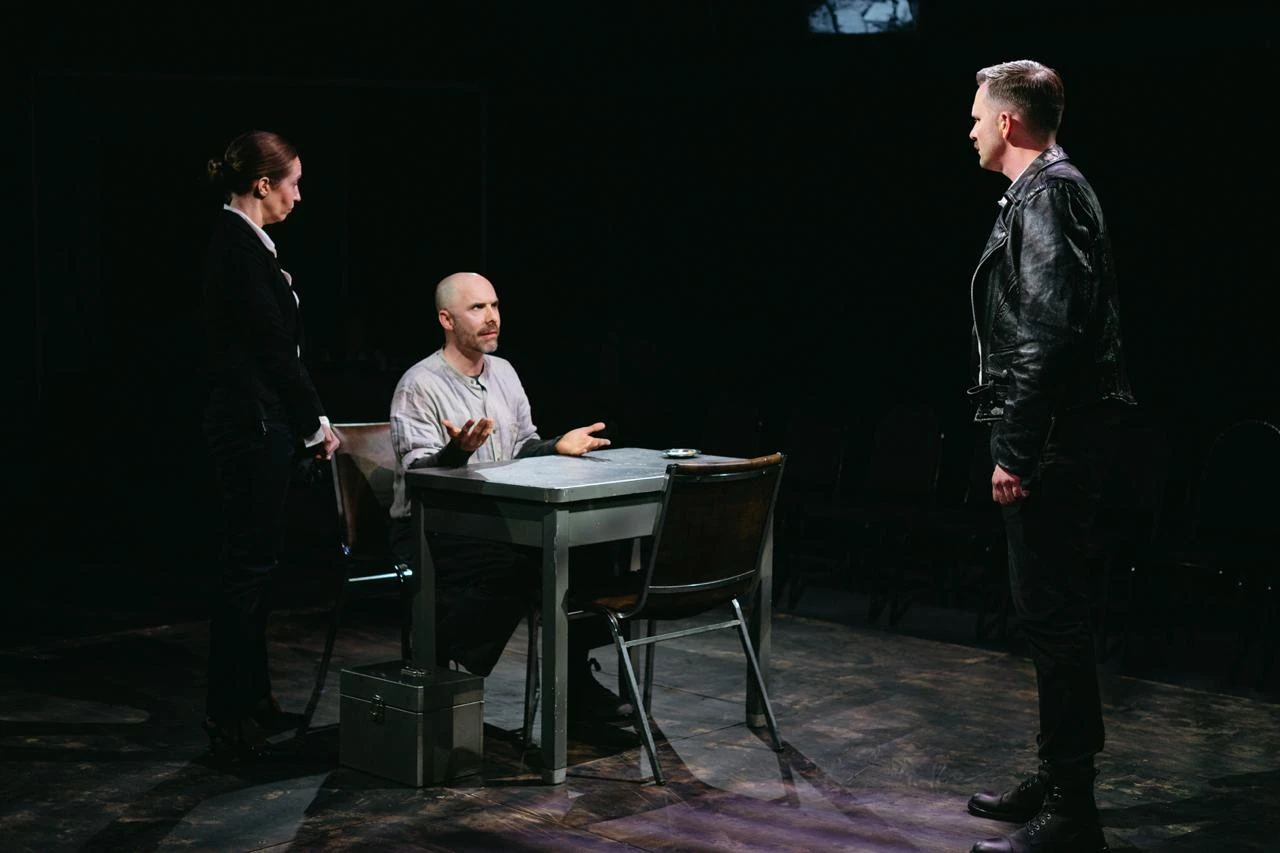
At the center is Trevor Kluckman’s mesmerizing Katurian. From his first moments onstage, Kluckman makes the audience want to know everything about him. He is magnetic without seeming to work for it, and he grounds the role in such deep empathy that even the play’s most disturbing revelations never sever our connection to him. Katurian must hold together innocence, damage, imagination and terror all at once, and Kluckman does so with remarkable control.
Katie Johnston is equally compelling as Michal, delivering a performance with a beautifully modulated arc. Johnston makes Michal entirely convincing, and as the story progresses, both her line readings and her emotional clarity gain lucidity and force in equal measure. Whether that increasing sharpness reads as stress-induced, adrenaline-fueled or something else altogether, Johnston tracks it with precision. The result is a portrayal that keeps evolving right up to the end.
As Ariel, Daniel Austin charts one of the production’s most unsettling transformations. He enters as a figure of unnerving aggression and abuse, yet gradually reveals a deeply disquieting empathy beneath the violence. Austin understands how to preserve the character’s danger even as the audience’s understanding of him shifts, which makes Ariel far more complicated than a simple brute.
Kate McManus’ Tupolski is written as disconnected and cruel, someone so thoroughly enclosed within her own twisted worldview that she can say and do obviously monstrous things while still regarding herself as right and good. That coldness is central to the character’s function in the play, though the performance itself feels more static than the others surrounding it.
The technical elements are where this production becomes genuinely extraordinary. James Tucker’s lighting design utterly transforms the space. From the interrogation room’s dim, chilly blue-white glow — suggestive of badly maintained fluorescent bulbs — to the sweeping mover effects that carry us into the woods and other increasingly sinister locations, the lighting is consistently immersive and precise. It shapes the world of the play without ever overwhelming the performances. The use of video security monitors is especially brilliant, giving the audience a palpable sense of surveillance and making the act of watching feel central to the production’s tension.
Andrews’ sound design is equally impressive, providing rich aural storytelling that fills in the cracks of the world beyond the interrogation room. The design does not merely accompany the action; it deepens it, building a full-sensory environment that sharpens dread and expands the production’s emotional reach.
Laurén Paragallo’s costumes are quietly unnerving in exactly the right way. In a story that gives only the barest glimpse of the world outside the interrogation room walls, the costumes do a great deal of world-building. The high-fashion, slim-fitting and almost elegant looks worn by the police stand in striking contrast to the more worn, utilitarian clothing of the Katurians. That visual divide says volumes about power, class and the machinery of control.
One of the production’s best choices is having the actors read the stories directly from the files. It gives those stories a startling autonomy, as if they are a fifth member of the cast rather than merely inventions living in Katurian’s mind. They become tangible. They exist in the room as objects with their own weight and consequence. Just as effective is the play’s refusal to answer every question cleanly. So much is left beautifully unresolved, forcing the audience to decide for itself what was real, what happened and what meaning, if any, can be extracted from the wreckage.
Not everything works. The props are a rare weak point in an otherwise carefully built world. Tupolski’s sidearm reads as distractingly oversized, particularly worn visibly at the hip beneath a jacket that never quite accommodates it cleanly. More damaging is the device used to threaten torture. In a proscenium house, perhaps the production might have gotten away with it, but in WJCT Studio B’s intimate space — where the furthest audience member is only feet away — the fact that the “electrodes” are attached to what looks like an analog multimeter undercuts the menace and earns an unintended chuckle.
The Pillowman remains a powerful story that asks questions worth asking, even if it could stand to take itself less seriously and its editing more seriously. Lumen Rep has mounted a remarkable production of an unwieldy play, one elevated by mesmerizing performances, stunning design and a clear directorial command of tone. If the script itself were leaner, the evening might be devastating. As it stands, it is often compelling, sometimes profound and undeniably overlong.
The Pillowman runs Thursday, April 23 through Saturday, May 9 at the WJCT Studio B.
For more information, full cast and crew credits and links to tickets, visit the The Pillowman page here on JaxPlays.
JaxPlays applauds our sponsors. Join them.